
This 5 days tour from Marrakech to Fes is a deep journey through Morocco’s landscapes and cultures. It connects the Atlas Mountains with the Sahara Desert and finishes in the historic city of Fes. Along the road, the scenery changes slowly. Mountains become valleys. Valleys turn into desert. Life adapts to climate, water, and land. This journey allows you to understand Berber communities, their traditions, family life, agriculture, and relationship with nature. You will see how women manage households and farming, how children attend school in remote areas, and how communities preserve their identity across generations. This tour is ideal for travelers who want meaningful travel, not rushed distances, and real contact with local life.
Itinerary 5 days tour from Marrakech to Fes
Day 1 – Marrakech → High Atlas → Ouarzazate
We leave Marrakech in the morning and begin climbing the High Atlas Mountains. The road crosses high passes and remote villages built from stone and earth. Agriculture here depends on altitude and seasons. Families grow barley, wheat, and vegetables on terraces carved into the mountains. Water is precious. Irrigation channels guide snowmelt to small fields. Women are often seen carrying water, preparing bread, or working the land. Children walk long distances to school, especially in winter, showing strong community values around education.
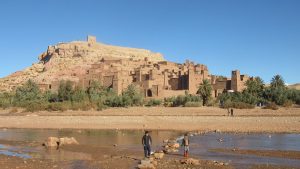
As we descend toward Ouarzazate, the climate becomes drier. Houses change shape. Flat roofs replace sloped ones. Clay and mud dominate architecture. Ouarzazate has long been a crossroads between north and south. It reflects Berber and Saharan influence. Local markets show daily life rather than tourism. Overnight in Ouarzazate allows time to understand the transition from mountain life to desert regions.
Day 2 – Ouarzazate → Roses Valley → Dades Valley
After breakfast, we travel toward the Roses Valley near Kelaat M’Gouna, a fertile region shaped by rivers and seasonal rainfall. This area is famous for rose cultivation. Every spring, families harvest roses by hand. Women play a key role in collecting petals and producing rose water and oils. The Roses Festival celebrates agriculture, music, and community pride. It is not only a festival. It is a reflection of how land, culture, and family life are connected.
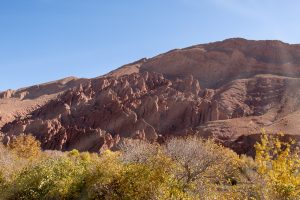
We continue to the Dades Valley, known for its dramatic rock formations and kasbah villages. Agriculture here relies on oasis systems. Date palms protect crops underneath. Vegetables grow in narrow plots. Life is organized around water distribution. Children help families after school. Women manage both home and field work. The climate is semi-arid, with hot summers and cold winters. Overnight in the valley offers calm surroundings and insight into rural Berber life.
Day 3 – Dades Valley → Todra Gorge → Merzouga Desert
The road leads through changing landscapes toward Todra Gorge, where massive limestone cliffs rise vertically. Water carved this canyon over thousands of years. Villages at the base of the gorge depend on small farms and livestock. Goats, sheep, and date palms are central to survival. Children play near the river. Women wash clothes and manage daily tasks. The gorge shows how humans adapt to natural limits.
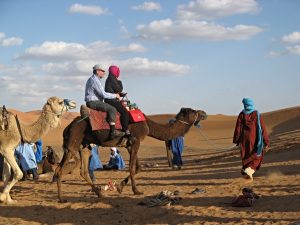
In the afternoon, we continue toward Merzouga, crossing desert plateaus and fossil-rich lands near Erfoud. This region is known for its date agriculture and the Erfoud Date Festival, celebrating harvest and desert culture. As we reach Merzouga, the dunes appear gradually. The Sahara is not empty. It is a living environment shaped by nomads and settled families. Camel trekking at sunset introduces the rhythm of the desert. Night in a desert camp under the stars offers silence and reflection.
Day 4 – Merzouga Desert → Nomads and Local Communities
The day begins with sunrise over the dunes. Light changes quickly. Temperatures shift from cold to warm. Desert life requires adaptation. We explore nearby Berber and nomadic communities, learning how families live with limited water and extreme climate. Nomads move seasonally with animals. Women manage tents, food, and children’s education when possible. Some children attend nearby schools. Others learn traditions directly from family life.
Music, storytelling, and hospitality are central to desert culture. Dates and milk are staple foods. Clothing is practical, designed to protect from sun and sand. The afternoon allows time for walking dunes, resting, or camel rides. A second night in the desert deepens understanding of Sahara life beyond images and clichés.
Day 5 – Merzouga → Ziz Valley → Middle Atlas → Fes
We leave the desert and follow the Ziz Valley, one of Morocco’s longest palm valleys. Thousands of palm trees support agriculture and shade crops below. Villages are built close to water sources. Women work in fields and homes. Children attend schools along the valley. Life here is structured around farming cycles and climate.
As we climb into the Middle Atlas Mountains, the landscape changes again. Forests appear. Temperatures cool. Cedar trees dominate the hills. Small towns show a different rhythm of life, with seasonal clothing and mountain traditions. By late afternoon, we arrive in Fes, Morocco’s spiritual and cultural capital. The journey ends, but the understanding of Morocco’s diversity remains.

Included
- Private air-conditioned vehicle with driver-guide
- 4 nights accommodation (hotels and desert camp)
- Breakfast and dinner
- Camel trek in the Sahara Desert
- Pickup in Marrakech and drop-off in Fes
- Cultural explanations throughout the journey
Not Included
- Flights
- Lunches
- Drinks and personal expenses
- Travel insurance
- Optional activities not mentioned
Book This Tour
To book this 5 days tour from Marrakech to Fes, send an email with:
- Travel dates
- Number of travelers
- Special requests
The itinerary can be customized to your pace and interests.